



BrokersConfirms aims to provide you with the right choice of an offshore exchange.
Today, the most important topic that allows us to understand FX margin trading as “the essence, not the appearance,”, FX How the structure of the market and prices are formeddeals with.
Many investors trade based on charts alone, but in reality, behind the charts lies a lot of information.
- Who creates the price
- What stages of the trading flow exist
- How does the broker transmit the price information through a technical structure?
Understanding this basic structure accurately can help reduce unnecessary misunderstandings and losses.
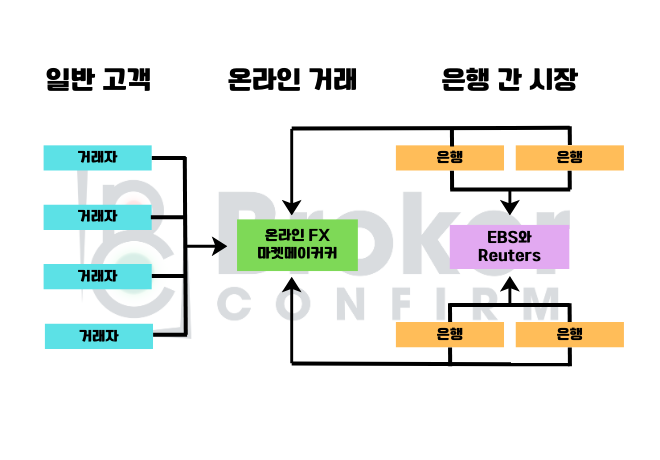

How is the FX market structured?
The FX market is an over-the-counter (OTC) market without a central exchange, like the stock market.
That is, it is not a "structure where prices are created on someone's server and shared by the whole world,",
Financial institutions around the world come together to form a single foreign exchange market by connecting them through a network.
1) EBS (Electronic Broking Services)
It is a system operated by the CME Group.
The criteria for derivatives 'Create a price'It serves a role.
It is an exclusive system for Interbank, in which large global banks participate directly, and even short-term companies can access it, providing extremely abundant liquidity.
2) Reuters Matching (Reuters matching system)
It is part of the core group that creates the foreign exchange market along with EBS.
It is an interbank foreign exchange matching system and a large-scale financial network that is linked to interest rates, bonds, and swaps.
Global 'Matching FX orders between banks in real time'And it is also used naturally in derivative products.
As expected, there is plenty of liquidity and the price is highly reliable.
The core of the global foreign exchange market: the interbank market
At the very top of the foreign exchange market is the 'foreign exchange trading market between banks'.
The following organizations are involved in this project:.
- Banks like JPMorgan and UBS
- Hedge funds, global fund companies
- Multinational companies and trade companies (foreign exchange in the import/export process)
- Central Bank
These institutions are considered to constitute the most real-time exchange rates.
Therefore, this "interbank exchange rate" is transmitted to the following stages,
The basis for the final price that is passed on to brokers-tradersThis is the structure that becomes this.
The role of liquidity providers (LP)
Many of you have probably heard about LP at least once by now.
In the market, the most important entity, especially for our individual traders, is the liquidity provider.
LP can be divided into several configurations, providing real-time prices and liquidity to brokers (exchanges).
✔ Key features of LP
-
Real-time price display (price feed)
-
Broker placing orders
-
Offering a spread
-
Large-scale order handling
✔ Types of LP
| Type | Description |
|---|---|
| 1) Tier-1 bank LP | Top-tier pricing provided by Citi, UBS, Barclays, etc. |
| 2) Non-bank LP | HFT-based platforms such as XTX Markets and Jump Trading |
| 3) Prime of Prime (PoP) | An intermediary LP that connects brokers and banks |
| 4) Internal LP in the broker | Some MM brokers set their own price structure |
An FX broker does not only connect a single LP.
By aggregating the prices of multiple LPs, we create a more dense spread.
Brokers structure: STP / ECN / MM
The final step in which the FX price is communicated to traders is Brokers structureIt is.
✔ 1) STP (Straight Through Processing)
-
The broker passes the customer's order directly to the external LP
-
The broker earns money from a portion of the spread + fees.
-
Minimizing internal interference
2) ECN (Electronic Communication Network)
-
Bringing together the market prices of multiple LPs into one to submit customer orders in the actual market in the form of "bid/offer"
-
Highest level of transparency
-
Instead, charge a fee
-
The spread is the narrowest (such as 0.x pips)
3) MM (Market Maker)
-
The broker internally takes and closes the opposite position of the client's order
-
There are many misunderstandings because of the structure where customer losses are equal to broker profits.
-
Actually, most of the hedging systems are built and there are no structural problems.
-
The structure with the fastest execution speed for individual traders
How are FX rates calculated?
The price is formed according to the following flow:.
Interbank Market → Tier-1 LP → Non-Bank LP → Aggregator → Broker → Trader
In the simplest form, it can be summarized as follows:.
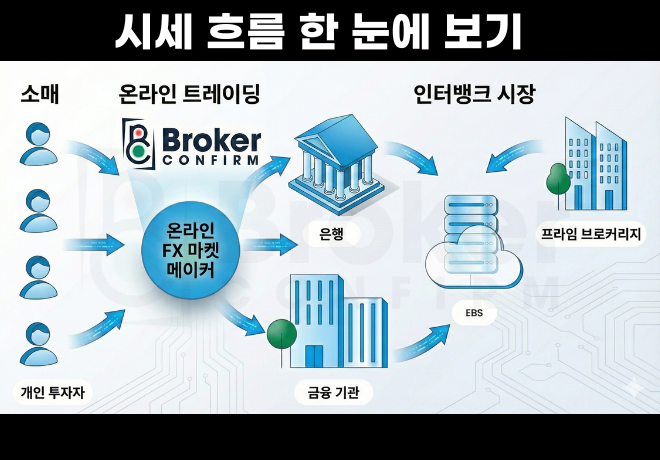
The broker's technical infrastructure: servers, aggregators, and underlying connections
The broker provides a stable trading environment through the following technological infrastructure.
✔ A. Price Aggregator
We aggregate the prices received from multiple liquidity providers to create the optimal spread by combining the lowest Bid and the highest Ask.
✔ B. Matching Engine
It is an engine that matches and concludes customer orders.
The speed of the transaction varies greatly depending on the server location.
Example:
-
New York (NY4/NY5)
-
London (LD4/LD5)
-
Hong Kong (HK1)
Recently, brokers are actively using Hong Kong data centers for Asian clients. (Vantage Market is one example)
✔ C. MT4/MT5 server structure
-
Main server
-
Price server
-
History server
-
Back-office server
The more stable the server structure is, Sleepy, Jaeho, and Delay are reduced.


The actual execution process of FX trading
The table below shows what actually happens internally when a trader presses the "Buy" button.
| Steps | Description |
|---|---|
| 1 | Order requests in Trader MT4/MT5 |
| 2 | Order confirmation on the broker server |
| 3 | Aggregator selects the optimal LP price |
| 4 | Place an order with LP |
| 5 | LP responds to the broker after placing the order |
| 6 | Execution information is transmitted to MT4/MT5 |
This entire process Millisecond units (0.01~0.05 seconds)It is done by.
The reason why price manipulation is difficult
Because there is no centralized exchange in the FX market,
"There is a misconception that price manipulation is easy, but in reality it is the opposite.
✔ Reason 1: Hundreds of LPs are supplied simultaneously
If an LP experiences an unusual price movement,
The remaining LP is automatically filtered based on the price sent by the other LP.
Reason 2: The broker must use the Aggregator
The broker uses the most reasonable bid among dozens of quotes in the aggregator.
✔ Reason 3: The benchmark for global interbank transactions
The top floor of the FX market Interbank (Bank-to-Bank) It's a rescue operation
No one can arbitrarily determine the price.
Time zones and volatility structure in the FX market
The FX market moves 24 hours a day.
The flow of volatility varies completely depending on the time zone.
✔ Asian session
-
Low volatility
-
Focus on JPY, AUD, and NZD
✔ London session
-
Most liquidity during the day
-
Increased volatility in EUR·GBP
✔ New York session
-
Focus on news and indicator releases
-
Strong fluctuations in XAUUSD and NASDAQ
Especially London+New York overlapping time (21:00~01:00 KST)은
This is the time when the strongest movements occur in the FX market.
Transaction cost structure: spreads, fees, swaps
| Items | Description |
|---|---|
| Spread | Bid/Ask difference |
| Fees | Fixed fees charged per lot on ECN accounts |
| Swapping | Occurs based on the interest rate difference between currencies during rollover |
Because each broker has a different LP connection method,
The spreads and fees also vary.
Technical factors to consider when choosing a broker
By understanding this market structure,
When choosing a broker, it becomes clear "where to look.".
✔ The broker confirms the investigation.
-
Is the LP structure transparent?
-
Is the server location close by?
-
Is there a physical server in NY/HK/London?
-
Whether STP/ECN/RAW accounts are provided
-
Whether Slipiye statistics will be released
-
Volatility fluctuation stability
-
Whether or not the company holds regulatory licenses
Understanding the structure of the FX market reduces unnecessary misunderstandings.
The point is as follows:.
✔ FX does not have a central exchange Over-the-counter market among banksIda
✔ LP to the broker Price, Liquidity, and ExecutionThey are the key beings that provide
✔ The broker forms liquidity through the STP/ECN/MM structure
✔ The signing process is mostly completed in less than a second
✔ The reason for price manipulation is clearly 'structurally very difficult.'
✔ The broker's technical infrastructure and LP configuration directly affect the quality of real-time trading
The FX margin market is not a simple chart market.
A complex system where the global financial network operates in real timeThat is, this.



